
Meredith before and after her diagnosis.Credit : Meredith/TikTok (2)
When Meredith was 23, she was everything most people her age aspire to be — healthy, active, and building a career she loved. Then, in November 2021, her life changed in a way she says nothing could have prepared her for.
What began as unexplained dizziness and intense head pressure escalated suddenly on Thanksgiving Day. A crushing “thunderclap” headache hit, followed by a seizure. She was rushed to the emergency room, told to rest, and sent home. But the pain never left.
Today, at 28, Meredith spends nearly 95% of her day lying flat, because standing upright for even a few minutes leads to unbearable pain.
A Life Turned Upside Down Overnight
“Every part of my life has been affected,” Meredith says quietly. “I was young, extremely active, and had a career I loved. I lost all of that almost overnight.”
January 2026 marked her fifth birthday spent bedridden, a milestone that carries both heartbreak and reflection. Meredith describes not just mourning the life she once had, but grieving the future she imagined for herself.
For many people living with chronic illness, that grief is invisible — but deeply real.
The Diagnosis That Explained Everything — And Changed Everything
After nearly two years of relentless migraines, endless medical tests, and advocating fiercely for herself, Meredith finally received a diagnosis in August 2023:
a spinal cerebrospinal fluid (CSF) leak causing spontaneous intracranial hypotension.
In simple terms, CSF is the fluid that cushions and protects the brain and spinal cord. When it leaks, the brain can lose that critical support.
Meredith’s case is especially rare and complex. Instead of fluid slowly leaking out through a tear, she has a CSF-venous fistula, where the fluid is pulled directly into a vein and absorbed into the bloodstream. That makes it significantly harder to detect — and even harder to treat.
As Meredith explains, “You can’t truly understand a CSF leak unless you’ve lived it.”
Why Treatment Is So Difficult
Over the years, Meredith has undergone multiple blood patches, invasive procedures, and even the placement of a brain stent. Yet sealing one leak often leads to another.
A contributing factor is her connective tissue disorder, Ehlers-Danlos syndrome (EDS), which makes her body more vulnerable to recurring leaks. Ironically, even diagnostic testing can create new problems, since locating a CSF leak often requires puncturing the spinal canal.
CSF-venous fistulas are also notoriously hard to detect on scans, often requiring repeated attempts — each carrying its own risks.
Living Nearly Every Day Lying Flat
To manage her symptoms, Meredith spends most of her life horizontal.
“I eat with my head slightly elevated. I brush my teeth in bed. I only get up for absolute necessities,” she says.
Even simple daily tasks like washing her face or making a snack can feel impossible. When upright, the pain is overwhelming.
“When your brain is essentially sinking into your skull, pain medications don’t help,” Meredith explains. “The only option is lying flat.”
As the leak persists, symptoms worsen. Severe neurological and ear-related issues have left her unable to work and limited her social interactions to very brief visits.
Physically, her body has deteriorated. Mentally, she faces an exhausting daily decision: to keep fighting.
Finding Meaning and Moments of Joy
Despite everything, Meredith refuses to let her diagnosis fully define her.
She’s learned to adapt — getting her hair done while lying on a massage table, holding her nephews while they nap, and finding accessible beaches where she can still feel connected to the world.
“These moments give me little glimpses of normalcy,” she says.
One of the most emotional moments of her journey was her wedding. Instead of walking down an aisle, Meredith spent much of the day resting on a fainting couch at a rented historic home.
“It wasn’t how I pictured my wedding,” she admits. “But it taught me how to find joy in what I can still experience.”
Her husband, family, and friends have become her emotional backbone — helping with daily challenges and reminding her that hope still exists.
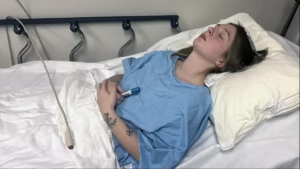
Meredith in the hospital.Meredith
Turning Pain Into Purpose
For the past three years, Meredith has shared her journey on TikTok, documenting the realities of living with chronic illness.
Her goal is simple but powerful: awareness.
“I want people to understand that disability doesn’t only happen to ‘other people,’” she says. “It can happen to anyone — and many disabilities are invisible.”
Through her story, Meredith advocates for more research, better treatments, and, above all, compassion.
“We don’t always see what someone is struggling with,” she reminds us. “That’s why choosing understanding over judgment matters so much.”
#ChronicIllnessAwareness #InvisibleDisability #CSFLeak #HealthJourney #NeverGiveUp